Showing posts with label Branford Marsalis. Show all posts

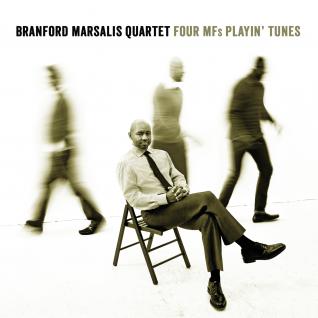
Branford Marsalis: Four MFs Playing Tunes

Branford Marsalis (sax)
Four MFs Playing Tunes (Marsalis Music; 2012)
Joey Calderazzo (piano)
Eric Revis (bass)
Justin Faulkner (drums)

Branford Marsalis can always be counted on for great album titles in addition to the superb quality of the music (e.g. I Heard You Twice The First Time). With his latest, Four MFs Playing Tunes, I think he might not be able to top himself this time. Yes it is a very striking title, but the music and development of the quartet is sensational.

The core of the group has remained the same for years. The difference now is the refreshing presence of Justin Faulkner. Replacing longtime bandmate, Jeff "Tain" Watts, Faulkner provides an extra boost of energy that the group just absorbs into what was already a very creative and electric force.

The new quartet also shows serious growth, and Marsalis provides the room through a number of the tunes written by Revis and Calderazzo (in addition to Marsalis). Now this isn't really anything new, but this material has a real electricity to it that shows each member's growth as composers.

The bluesy tone of "Brews" (written by Revis) has a flow that is true blues, but Calderazzo and Marsalis give it a playful nature. At the same time Revis and Faulkner provide the calm layer of seriousness to the track making it very balanced and effective. The Thelonious Monk tune "Teo" shows how fluid and instrumental Faulkner has become in an extremely short amount of time with this group. His performance in the beginning conversations with Branford is awesome and you can see Branford has an immediate connection with him. Faulkner's kit sounds almost tribal. Eric Revis and Calderazzo also have some sweet, quiet funky moments in the middle of the piece. Revis' bending of the chords like a young Paul Chambers. This is juicy stuff, folks.

"Endymion" is beautiful chaos. A tune is built around Marsalis' rolling third notes. The group improvises at every turn allowing the notes to slowly create their own melody. Marsalis has written a piece in which each member shines at their craft. Faulkner shows considerable strength and versatility as he is called upon many times throughout this number to carry and challenge his bandmates.

Four MFs Playing Tunes is a fresh new beginning for the Branford Marsalis Quartet. While it maintains the playfulness Branford carries on all his albums, his group has managed to breathe new life into their adventurous spirit. Four MFs Playing Tunes is a must own album this year.

Tomasz Licak/Artur Tuznik Quintet

Tomasz Licak (sax) & Artur Tuznik (piano)
Quintet (Blackout Music; 2011)
Andreas Lang (bass)
Anders Mogensen (drums)
Tomasz Dabrowski (trumpet)

A wonderful discovery for me in the last few days has been a quintet session from Tomasz Licak and Artur Tuznik. This fairly new (in terms of lineup) Polish/Danish quintet are young but possess the great energy and punch of their influences. The group combine a sensual style of contemporary modern with well crafted improvisation. Their latest release, simply titled, Quintet feels like mid-period Branford Marsalis or an adventurous One For All.

The group manage to sound well at home in the modern hard bop setting as they do when they let the rhythm fly. "Uwaga" comes pounding out of the speaker with vigour. Tuznik and Mogensen drive the beat with cinematic effect. Tuznik shapes the piece with somber relaxed movements intertwined with improvised changes. These are cut across boisterous chords from the horn section which make "Uwaga" a massive opening statement.

"Lightblub In Green" reminds me of the best moments of being in a jazz club and closing my eyes to the rhythm. Lang and Licak have a lovely exchange midway through that could resemble Jackie Mclean and Paul Chambers at their Blue Note best. The quintet quietly swing with verve and each member's contribution is heard crystal clear. The tone is lowered on the melodic and beautiful "Nardis" (also featured on their previous album as Last Call). It's a technical and introspective piece where Tuznik takes center stage and delivers a performance that slowly envelops you with very powerful emotions. Tearful.

While most of the material on Quintet has a contemporary atmosphere, "Hobbit" rips the cover off the box and the group conjure up a funky groove built inside patterns of free jazz. It may have the uninitiated shaking their heads and they will eventually be sucked into the groove. There are individual moments where band members create subtle colours and tones and then return to the fire free form of their original theme.

Quintet is a stellar addition to the brief catalog of Licak and Tuznik and they will definitely be one of the creative duos that we will be talking about in the next few years. I loved this record and think its a must for every music fan. And I'm not just talking jazz fans. This is the wonderful balance between contemporary and free jazz.

Re-Thinking...Benjamin Drazen

Benjamin Drazen (sax)
Inner Flights (Posi-Tone Records; 2001)
Eric McPherson (drums)
Carlo De Rosa (bass)
Jon Davis (piano)

I normally shy away from re-posting but a couple of weeks ago I went to visit a friend a few states/provinces away. I took Benjamin Drazen's Inner Flights as one of my "driving albums". I ended up listening to the album for four days straight. In and out of the car. Inner Flights has become an infectious record for me on various technical, thoughtful and entertaining levels. It has also become a contender for top albums over the year. So I decided I really wanted to share my original thoughts on this album with some of you again.


There is something warm and positive about Benjamin Drazen that keeps me coming back to Inner Flights (Posi-Tone Records). Drazen, a veteran of the New York scene has performed in various settings (funk, jazz and soul) as well as with some prestigious company (Rashied Ali, Dave Liebman, Lew Soloff and Gary Bartz to name a few). It is a surprise that Inner Flights is his first album as a leader.

Pretty much growing up in the New York scene, Benjamin Drazen shows wonderful penchant for strength in performance and melody. The opener, "Mr. Twilight" is a fast paced number with real intent. Drazen bring a muscle to his musicianship that I haven't heard since early Branford Marsalis or Eric Alexander records. While the obvious compositional influences are there (Sonny Rollins, Thelonious Monk and Jackie McLean) Drazen makes his individual voice known very quickly and I think every lover of jazz will gravitate to him, no problem.

The follow up "Monkish", a playful and appropriate tribute, delivers with great verve. The quartet, especially Jon Davis on piano will have you imagining Monk setting in the audience saying "This kid is pretty good" (Well, maybe Monk wouldn't say it so nicely). The title track, "Inner Flights" and "Neeney's Waltz" both add depth, intensity and intimacy to the sessions. The quartet shows a real richness and lovely craftsmanship that switches from a uptempo funky groove (in the case of "Inner Flights") to delightful romanticism ("Neeney's Waltz").

"Kickin' Up Dirt" highlights Benjamin Drazen's more soulful side. It's also an opportunity for DeRosa to standout as well, with some touching and fluid pace on the bass. The closing number is the standard, "Polka Dots And Moonbeams" which seems the perfect way to end this outing. Drazen makes it a lush, bluesy and beautiful affair. He doesn't oversimplify the passages here. He just let's the melody speak for itself but he ends up having the listen remember exactly who is performing.

Benjamin Drazen, after all these years on the scene gets to standout on his own and he delivers with a real diamond of a debut. Inner Flights features mainly all original material and will definitely impress even the non jazz fan. I really had to put listen to this a couple of times because I kept saying to myself, "this can't be this good." Man, I was so wrong. This is really impressive. So if you are reading this blog for the first time or if you've been reading it for awhile--Inner Flights is one of those classic, straight ahead jazz records that is rare nowadays and well worth your time. Enjoy listening...

Best Albums Of 2010: Soweto Kinch

Over the next two weeks JazzWrap revisits our favourite albums of 2010.

Soweto Kinch (sax, vocals; b.1978)
The New Emancipation (Soweto Kinch Recordings)

Resurfacing this year with an incredible document, The New Emancipation (SK Recordings), Soweto Kinch may have established himself as the premier storyteller of the new British jazz generation influenced by Hip Hop. This fertile underground mind delivers the trials and tribulations young London life trying to reach the better horizon.

That story is capsulized in perfectly on the opener, "Trying To Be A Star". Maybe in a similar fashion as some of Courtney Pine's earlier records but with a more updated and solid vision.

One of the brilliant things to come out The New Emancipation for me was the way Kinch has grown as a musician on sax. His playing especially on the hard bop of "A People With No Past" is very reminiscent of Branford Marsalis circa Crazy People Music. In the first two full tracks Kinch has made his case that Jazz and Hip Hop an coexist within the same sphere.

The influence of both someone like Branford, Sonny Rollins, Jackie McClean and Hip Hop artists Mos Def, KRS-One and Black Thought (of The Roots) can be felt throughout Soweto's discography but even more so on The New Emancipation.

And it's not just Soweto who stands out here either. He's band a superb. Guitarist, Femi Temowo and drummer Justin Brown act as wonderful counters to Kinch's fierce, rolling vision on the more traditional jazz pieces, including "The Never Ending" and "Suspended Adolescence."

The rhythm based pieces such "Raise Your Spirit," "Axis Of Evil" and the hilarious "Paris Heights" show the lighter yet bold side of Soweto's lyrical storytelling. But overall, The New Emancipation is sold jazz album. It balances Hip Hop and Jazz to perfection. This lyrical delivery of Soweto Kinch has never been more clear than now. Soweto has become a more mature and focused player and songwriter.

The New Emancipation is not only a statement of our culture. It is a blueprint of what Jazz and Hip Hop should sound like. It was one of my favourite albums during the second half of the year and I haven't stopped listening.

Soweto Kinch: The New Emancipation

Soweto Kinch (sax, vocals; b.1978)
The New Emancipation (Soweto Kinch Recordings)

Ok so this is the part where I say, "this is going to be one my albums of the year." While let's just say 2010 has been a really good year for jazz. Mainly new stuff. New and creative stuff. I can tell everyone right now that my number one and number two albums are...eh, er, uh--well, why don't we wait a few more weeks for that. Today I did want to talk about what will definitely be on my top albums for year.

The long and arduous return of the jazz-hip hop alchemist, Soweto Kinch. I've discussed, London based, Soweto Kinch's incredible qualities before but I think on his new album The New Emancipation (SK Recordings) he has finally achieved the promise and hope that some many of us who have followed him over the years have been waiting for. The New Emancipation is sheer brilliance for a new century.

Early in his career, Soweto Kinch was guided by current British jazz legends Gary Crosby and Courtney Pine. After receiving a nomination for the UK press coveted Mercury Prize and critical acclaim for his debut, Conversations With The Unseen (Dune; 2003). Conversations... as with its follow up A Day In The Life of B12 (Dune) were both commentary on struggles of black British youth. But they can also be observed as the struggles of everyone in lower to middle class around the world. The great thing about powerful music is that the themes when communicated right, stand the test of time. And with Soweto Kinch, I think we may have found another great communicator of the urban theme.

After a great one off single Jazz Planet (Dune), some legal wrangling with his former label and the still unreleased sequel to A Day In The Life titled Basement Fables, now on shelf (hopefully not forever) Soweto began releasing music again in 2009. The Live At iTunes Soho release and an amazing hard hitting hip hop/jazz mini album War In A Rack (SK Recordings) signaled that Soweto was back and stronger than ever.

Now this month with the release of The New Emancipation, Kinch has probably designed the best and clearest document of his vision of Jazz and Hip Hop to date. While the album is based on Soweto Kinch's recent studies on slavery, The New Emancipation is also about the not accepting the pressures that try to hold us down. It's about our efforts to learn and break free from conformity.

Opening with the complex, dichotomy of artist, record label, celebrity and making it rich, "Trying To Be A Star" and moving into the bristling hard bop of "A People With No Past"--very reminiscent of Branford Marsalis circa Crazy People Music. In the first two full tracks Kinch has made his case that Jazz and Hip Hop an coexist within the same sphere. The influence of both someone like Branford, Sonny Rollins, Jackie McClean and Hip Hop artists Mos Def, KRS-One and Black Thought (of The Roots) can be felt throughout Soweto's discography. This is good shit people.

"Suspended Adolescence" is a nice straightforward post bop piece which shifts perfectly into soulful rhythms of "Help" which bases itself in some gospel themes slowly dives into rolling, frenetic Kinch solo. Kinch has embraced his influences and produced some astounding material on The New Emancipation.

"Trade" is another piece of post bop brilliance that put Kinch up there with many of his American counterpart as his skills on the alto begin to flourish beautifully. "On The Treadmill" is a slice of New Orleans funeral jazz funk that sees Kinch and his band having a delightful interaction.

The New Emancipation balances the Hip Hop and Jazz tracks to perfection. This lyrical delivery of Soweto Kinch has never been more clear than now. But also his playing has become more mature and focused. This is an statement of our culture as well as deconstruction of what Jazz and Hip Hop should be.

The New Emancipation is by far one of my albums of the year. I hope everyone gets a chance to hear this because its absolutely brilliant.


Miles Davis and Hip Hop

Miles Davis (trumpet)
Doo Bop (Warners; 1991)

I said before the Miles' latter period (1985 - 1991) still needs to be re-evaluated by jazz fans and the outside listening public. Far to often it is shoved aside by the the monumental recordings that presided them (Rebirth of the Cool, Steamin', Workin', Kind Of Blue, Bitches Brew and On The Corner). But I think anyone who is going to listen to Miles' recordings has to eventually get to the point of "what's next?" "what do I listen to after the big records?"

Well, I think covering the final years of his life is a good idea. Not every record is great but they all do tell a story of what Miles was thinking and the direction he was looking towards. One such album is his final recording just before his death in 1991, Doo Bop (Warners).

Now for those who know this was a very incomplete record at best. Miles had been interested in R&B and Hip Hop for quite a few years at this point. He had actually recorded material with Prince a few years earlier. This material remains unreleased (or rumoured released on Prince's Black Album). So the idea and concept of Miles record a "street" dedicated album was really not out of the question. It was more "when" and "what" would it sound like.

I have to say 18 years later, Doo Bop sounds slightly dated but if you place yourself back in that time period, you know full well Miles was on to something. The album was recorded in few short weeks. The not all the material was even complete. In working with his collaborator/producer for the album, Easy Mo Bee, Miles felt a younger contemporary. This was someone he could drop some knowledge on as well learn more about the Hip Hop movement.

The opening "Mystery" with the infectious muted trumpet combined with muffled drum n' bass rhythm was Miles setting down a new marker for a new decade. You felt the futuristic street vibe Miles was searching for. That pounding message would carry through to "Chocolate Chip" with its slowed down mid tempo funky drummer beat and some excellent samples thrown in for good measure. A nice dance floor filler.

Miles was also influenced by vocal sounds of hip hop, so he incorporated rap into some of pieces (provided by Easy Mo Bee and J.R.. The rap pieces don't really work more because the lyrics are really weak and don't seem throughout well at all. The music itself compliments Miles very well. Miles and Easy Mo Bee do add a lot of though into the musical arrangements throughout Doo Bop. "Blow" has a "Pacific State" (song by English techno band 808 State) vibe to it that is very interested (despite the average lyrics laid on top).

Towards the end of recording sessions Miles had visited the hospital for some treatment. It would be turn out that Doo Bop would be the last record Miles Davis would record. The album was completed by Easy Mo Bee and since has received lukewarm reviews. In listening to Doo Bop again and again for this piece I realise there is a lot hear to absorb and I've been enjoying the adventure of going track by track. It's definitely an incomplete experience but its the insight into a legends way of thinking.

If you own the album take a listen again and think about some of the hip hop, techno that even some of the soul jazz that would come (Guru's Jazzmatazz, Branford Marsalis' Buckshot LeFonque, Roy Hargrove's RH Factor, et. el) --Miles was still ahead of the game.


Branford Marsalis: Steep Tradition

Branford Marsalis (saxophone; b. 1960)

Branford Marsalis is the oldest brother of the very famous Marsalis musical family. He has built his impeccable catalog of recordings in pop, rock, classical, hip-hop, film and university teaching. He and his quartet also had a brief stint on television as Jay Leno's house band on The Tonight Show when Jay first took over from Johnny Carson. But at the end of the day Branford Marsalis is and will always be a jazz musician. Not just a jazz musician but one of the leading, most respected, innovative and versatile of his generation.

Branford came to prominence in Art Blakey's Jazz Messengers along with brother Wynton. He also performed and recorded with the likes of Miles Davis, Herbie Hancock, Dizzy Gillespie and Sonny Rollins. His first debut as leader was Scenes In The City (Columbia Records, 1983). Scenes definitely shows Branford's growth as a musician. He would continue to carve out his own direction and identity through a series of phenomenal albums including Royal Garden Blues, Random Abstract, Trio Jeppy, The Beautiful Ones Are Not Yet Born and The Dark Keys.

Branford during this time would also perform with Sting and The Grateful Dead on the pop and rock side, and record soundtracks for Mo Better Blues and Sneakers. He also followed in his brother's footsteps by recording a number of classical releases, including another favorite of mine, Orpheus Chamber Orchestra entitled Creation. A full and diverse musical resume to say the least. In the late '90s Branford started his own label simply called Marsalis Music to develop various projects for himself and other artists (including Harry Connick Jr.).

One of my favourite albums of recent years is his most recent, Metamorphosen (Marsalis Music). Metamorphosen is a return to form of his earlier records--vibrant and rich in melody and invention. Tracks like "The Return Of The Jitney Man," "Jabberwocky," and "Samo" all have the tradmark Branford wit and composed brilliance that has set him apart from the rest of his generation of saxophone players.

With a catalog that includes over a dozen albums, you may be wondering were to start. The best place would be the very well crafted compilation The Steep Anthology (Columbia). The Steep Anthology covers a good selection of his best jazz albums from his years with Columbia. Highlighting some important and outstanding Branford staples; "Doctone," "Royal Garden Blues," "Spartacus," and "The Dark Keys"--it's a great overview of his playing style from cool and collected bop to more complicated melodic rhythms. Well worth the purchase and it will definitely put you in the right direction for finding which album to buy next.

One of the greatest jazz musicians of the last 25 years, Branford Marsalis will certainly will be mentioned in the same pantheon as legendary saxophonists, Coltrane, Hawkins, Rollins and Gordon in the next 25 years.


Kenny Kirkland

Kenny Kirkland (piano; b. 1955 - d. 1998)

Unfortunately known mostly as a session man (mainly with Wynton Marsalis and then Branford Marsalis' bands), Kenny Krikland was one of the most sought after pianist of the 80s and 90s. Highly regarded for adding a big dynamic to the aforementioned groups, Kirkland was influence by fellow piansts, Herbie Hancock, Kenny Barron and saxophonist Wayne Shorter. Kirkland got his start in the mid-seventies playing with jazz violinist, Michael Urbaniak and then later with ex Weather Report bassist, Miroslav Vitous.

Kenny Kirkland began playing with Wynton from '81-'85 providing providing many exquisite moments to Wynton's earliest recording (including Wynton's self titled debut and the classic Black Codes). Kirkland left Wynton's band to join former Police lead singer, Sting on touring and for the recording of Sting's first solo record, The Dream of Blue Turtles. The band also included Wynton's older brother Branford. While his association with Sting was brief it obviously raised his profile immensely. Kirkland and Branford both left the band shortly after a massive world tour in support of the release.

Returning back to the jazz scene, Kirkland would join Branford Marsalis permanently from '86 onward. The miraculous and unbelievable thing is Kirkland after all these years had never recorded an album as leader. It wasn't until 1991 that Kirkland would release, Kenny Kirkland (GRP Records). While long in coming it was a fantastic and beautiful album featuring mixture of self penned numbers and covers (Thelonious Monk, Ornette Coleman and Wayne Shorter). The album starts with the formidable "Mr. J.C." with some great work from Branford (sax), Charnett Moffett (bass) and Jeff "Tain" Watts (drums). The albums was a supergroup of nineties jazz talent; in addition to the aforementioned, Christian McBride (drums), Jerry Gonzalez (percussion), Steve Berrios (drums), Andy Gonzalez (bass), Don Alias (percussion), Roderick Ward (sax) and Robert Hurst (bass) all featured on selected tracks.

Another track "Chance", a trio piece with McBride and "Tain" displays the tonal beauty of Kirkland on the piano. Kirkland also tackles the Monk standard, "Criss Cross" with some interesting Latin arrangements that works surprisingly well if at first seems a little jarring. The album does cover a lot of ground, mixing different themes (bop, straight ahead contemporary and Latin) but it does show the breathe and depth of Kirkland's thinking.

This wonderful debut would be Kirkland's only album. He would continue to do session work and playing in Branford Marsalis' band throughout the nineties. In the winter of 1996 Kirkland was found dead in his apartment in New York. It was a devastating blow for the jazz community. Branford would later record and dedicate the album Requiem in Kirkland's honor. Kenny Kirkland was an amazing young talent who was only beginning to come into the peak of his power but his self-titled debut is well worth seeking out as a document of what he provided jazz history.


Bruce Barth

Bruce Barth (piano; b. 1955)

Very accomplished yet unassuming Bruce Barth has developed out a reflective post bop style that is bold as it is subtle. You really get this feeling more when you see him live. Bruce Barth is technically brilliant and highly effective with his compositions and interpretations. I have enjoyed his music for years now. Bruce Barth is one of those under-rated musicians of his generation. If someone doesn't tell you about him or you don't stumble across a live show in your city you may never know about him.

I first discovered him at a live show at the now legendary Smoke Jazz Club in New York City about seven years ago (maybe) not actually realizing years later that I actually met him once with Terence Blanchard as he was the primary piano player in Terrance's band during the early nineties (he also performed on a number soundtracks that Terence scored including Malcolm X). Bruce Barth has recorded 10 albums (and one DVD) as leader. All are quite rewarding and possibly owe a good deal to Chick Corea, Herbie Hancock and than Thelonious Monk and Duke Ellington (although Monk composition appear on quite a few albums).

In addition to working in Terrance Blanchard's band, Barth has also worked with Branford Marsalis, Wynton Marsalis, Joshua Redman, Tony Bennett, Karrin Allyson and Roy Hargrove to name a few. The years of work in Blanchard's group serve Barth well on his first few recordings including Morning Call (Enja), his second album as leader. This is highlighted by a great sextet including Leon Parker (drums), Steve Wilson (sax), Scott Wendholt (trumpet) and Larry Grenadier (bass). Morning Call is awash of Barth originals that show sophistication and beauty that I fell in love with after one listen.

Another standout album for me is the 2002 recording, Live At The Village Vanguard (MaxJazz) which is solid live recording (and the most widely available) mixed with spirited originals and elegant standards. A romantic yet smokin' live session that makes you feel like you're right there in the audience. It jumps, grooves and floats that you almost forget that its only a trio performing on the date.

Bruce Barth's latest album, Home (We'll Always Swing Music) is a live album with longtime colaborator Steve Wilson on saxophone. Home is an intimate performance and you can immediately tell that the two musicians have played with each other for years (since 1987). They are performing in front of just over 60 people at the home of a jazz supporter of the organization We'll Always Swing. Harmonically it might be two instruments but their interplay is so beautiful it sounds like one person. Barth again has written most of material for this evening including the compelling "The Ways Of The West" and rigorous "Blues Interruptus" which highlight Barth's considerable strengths as composer. There are only two standards played during this date, "All Through The Night" and "Sweet And Lovely". Both magnificently done and played with a loose combination of adventure and poetry. Home serves as an nice and long overdue follow up to Live At The Village Vanguard but I'm glad it's arrived.

I have a feeling many of you may not have heard Bruce Barth so I'm hoping I've convinced some of you that he is worth a listen. A good amount of his albums are available for download so that might be the best way to find him. He doesn't tour that often but if you should lookout for his name on the bill at your local jazz club. When he does show up--go. You won't regret it.


Celebrating Guru (Gangstarr and Jazzmatazz)

The Intersection: Keith Elam (aka Guru) (vocals; b. 1966 - d. 2010)

The news today that one of favourite lyricist, Guru, passed away today from cancer (Rakim, Chuck D and Black Thought being the others) is crushing. He along with DJ Premier were among a handful of innovators during the late 80's and '90s as Gangstarr. Guru's solo career was just as innovative with the creation of the collective Jazzmatazz.

Jazzmatazz was arguably the first jazz/hip hop hybrid (granted Branford Marsalis tried it as well with Buckshot Lefonque a year later) that established a critical and creative foothold in the musical culture during the '90s. Gangstarr had collaborated with Branford Marsalis on a great track from Spike Lee's little appreciated jazz movie Mo' Better Blues (Starring Denzel Washington) on the track "A Jazz Thing". Guru took a brief hiatus from the band after their third album and went into the studio with a treasure chest of ideas and closet full of legends to help him execute it. The result was one of the best fusions of hip hop and jazz ever.

With the help of Branford Marsalis (sax), Donald Byrd (trumpet), Ronny Jordon (guitar), the incredible Roy Ayers (vibes), Lonnie Liston Smith (keyboards) and a list of soul, R&B and jazz vocalist, Guru showed everyone that jazz and hip hop could take the next step forward creating a new evolution for both genres. The first album, Jazzmatazz Vol. I (Chrysalis) (a series of four to date) deals with the usual issues of the streets but the skill and delivery of both vocalists (including Guru) and the jazz legends makes this a real heartfelt affair and no matter whether you like jazz or hip hop this Jazzmatazz Vol. I really sticks inside you like glue.

Standout tracks like "Trust Me" featuring N'dea Davenport of jazz/soul group Brand New Heavies and "The Good, The Bad" featuring one of my favourite hip hop artists of all time, MC Solaar capture soulful essence of hip hop and easy coalesce with hard bop rhythm backed up by the jazz legends Guru has recruited. This is an album that satisfies both sides of the jazz/hip hop fence and if you haven't heard it you really need to check it out. The truly groundbreaking session. While this is a sad day for music, we should celebrate the legacy Guru has left us. Play It Loud.